
Last week I was sitting in the yard playing the guitar enjoying my freedom when I put down the guitar and picked up the London Review of Books and chanced upon that same Hamlet quote from last week’s agonized sermon on the disgustingness of sex. Cheesily teased on the cover as “Adam Phillips on FOMO” but more accurately titled inside as “On Being Left Out,” the article was, striking but, ok, kinda hard to read. I mean it’s interesting and you get the feeling that Adam Phillips has got the goods on Hamlet and Freud too but it’s a tough slog. The one thing that pulled me along was the fervent hope that I’d eventually get to the FOMO part. Which I never got to.
But the part where Phillips describes the Franz Kafka story fragment in which Kafka wins an Olympic gold medal in swimming without being able to swim was totally great. And the thing about how basically since we were once children we are always children, since once unable to swim always unable to swim, since once unable to have sex always in some sense unable to have sex, and with Sigmund Freud popping here and there, and all about Hamlet and Paradise Lost and all that, it was worth it somehow, and then what really gave me a jolt was down near the end he quotes the same Hamlet quote as last week’s anonymous commenter. I mean this quote:
Oh that this too too sullied flesh would melt,
Thaw and resolve itself into dew;
Or that the everlasting had not fixed
His cannon ’gainst self-slaughter.
Which made me go, Whoa. I think I actually said “Whoa,” because it vindicated my sympathy for the aforementioned commenter who wrote, “We only exist because of a rather disgusting, wicked drive, a drive that has no place in Heaven or even a Platonic ideal sphere,” which sympathy I was beginning to wonder maybe was misplaced, maybe he was just a jerk and why am I wasting my time. But no.
No, there is something complicated going on there, having to do with unresolvable conflicts, the Oedipus thing, the primal predicament, the meat grinder of just having parents, any kind of parents. Any kind. Because it’s always a nightmare getting born and having parents no matter how loud they yell when they’re having sex and whether or not they beat you. Having parents is just always a nightmare for a kid. The only thing worse is not having parents.
But anyway, then the Adam Phillips piece on FOMO leads me to a previous Adam Phillips piece in the LRB on St. Augustine:
His descriptions in Confessions of the baffling and unbaffled pleasure he took in sex, friendship, competition, cruelty, conversation, stealing, delinquency, reading, learning, feasting, entertainment, blood sports, and above all in himself and who he happened to be (his serial conversions from one stimulant to another), have always been reason enough to read the book, tempered though the pleasures have to be by his retrospective sense of having been a ‘slave’ to them. His infamous request to God – ‘Grant me chastity and continence, only not yet’ – makes the point. Eventually he will prefer ‘slavery’ to God over the other slaveries, and Confessions works hard to discriminate between them.
You see what I mean? St. Augustine was troubled by sex too.
But then, still thinking I was not writing a column but simply taking the day off, I go up to Piazza del Municipio to get some fruits and vegetables and have some tea at l’Antica Caffè de la Posta,
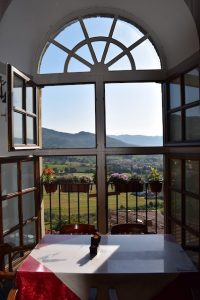 and I’m sitting outside totally enjoying the sweet pastry with walnuts on it (we had not yet returned to the utterly frivolous era of indoor dining) when I forgot that it’s Thursday and Thursday is Prospero the Nigerian Day.
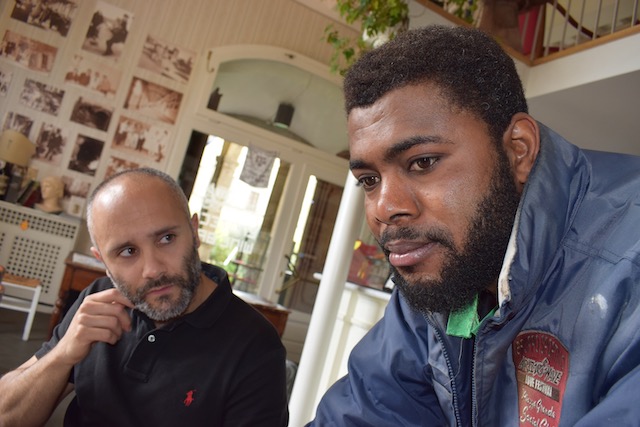
Honestly I think my brain is still screwed up by Covid-19, still scrambled by that vastly entertaining psychotic break I had last December in L’ospedale San Donato di Arezzo, because all week I’ve been one day ahead: Monday I thought it was Tuesday, Tuesday I thought it was Wednesday, Wednesday I thought it was Thursday. So by Thursday I was all mixed up and had completely forgotten that Thursday is Prospero the Nigerian Day, at which time customarily I duck down side streets to avoid his grip. Prospero the Nigerian is my friend and my tormentor, a man I love and respect but try to avoid because he will always take my money and give me socks, or a stupid flashlight. I personally believe that he is a brilliant salesman. Or he used to be, before his one prime technique was rendered off limits by the pandemic. Yes, when he could shake your hand, once he got hold of your hand and had his voice of sincere desperation cooing in the proper register, he couldn’t be beat. Even if you had already bought all the socks, handkerchiefs, washcloths, clothespins and cheap little flashlights you could ever use, still, as long as he had that hold on your hand he could usually wheedle a euro or two out of you. To the point that this morning I said “Here, let me just give you some money.” But no. He had this stupid flashlight for which in the end I paid ten euros. And he said to me, How is that book coming, the book about immigrants? And I thought, dude, you are an educated man, you taught agriculture in Nigeria, you need to get yourself a job. But of course that is close to impossible for him, for reasons having to do with Italian immigrant policy, Italian bureaucracy, Italian public sentiment, and probably his own prideful instincts of independence, which lead him to travel to towns all week with his bag of clothespins and handkerchiefs.
So to Prospero I said, somewhat defensively, “Well, It’s not specifically about immigrants, it’s about the building of Le Santucce mostly.”
You see, I had told him I was interested in writing about the immigrant experience because I’d gotten pickpocketed in Rome and had lost my drivers license and so had been taking the bus to the swimming pool in Cortona three times a week, and on the bus I observed the many African immigrants boarding the bus every morning to go to Arezzo for their Italian language lessons and appointments with the immigration authorities. These were the people about whom there was so much political fireworks, so much public resentment that had pushed the far-right parties to prominence. To an American, of course, the sight of newly arrived immigrants making their way was heartwarming and inspiring. But then, Italians are not indoctrinated since childhood with glowing stories of immigrants finding their way in a new land, becoming assimilated, etc.
Anyway … I didn’t get very far with the article idea because, speaking minimal Italian and being kind of shy anyway, I cannot go around Italy pretending to be a journalist. Aside from the fact that journalists in Italy must belong to the Order of Journalists.
(Speaking of journalists, lately they’re really getting the shit kicked out of them around the world. And, incidentally, a kindred spirit here basically saying [in Italian, of course] that journalism is not all about the likes and clicks. This in a piece about the payment policies of the site Blasting News.com, a topic to which all writers can relate.)
You see, just about four years ago, in the same caffè, I was interviewing my friend Luca Ghelli [for the Le Santucce book] about how his grandfather was thrown in jail by the Fascists for not joining the party. Because he just didn’t want to join the party. Who doesn’t love to join the Party? Come on, join the Party! The Fascists threw Luca’s grandfather in jail because he wouldn’t join their party. And Luca maintains that the jail he was thrown into is now the restaurant called Regiro, which Renato, proprietor, says is not exactly true. Everybody has a different story. I cannot get anything straight.
Then while we were having the interview, Prospero showed up. So then it was the three of us. Prospero told all about how he came to Italy eight years ago, having made it across the Mediterranean Sea to Italy’s southernmost island, Lampedusa, in a little craft called a Zodiac boat. Tricky thing, that. Which got us into the whole immigrant thing.
Life is tough for the many African immigrants who have fled war, famine, violence and poverty for the relatively better shores of Italy. But I, being by nature an optimist and an American, predict that in two or three generations they will have made brilliant contributions to Italian culture and will feel secure.
Anyway, about Luca’s grandfather, who worked for a wealthy landowner: The day after he was thrown in jail by the Fascists for refusing to join the party, in Luca’s Italian-inflected English, he says, “his owner came and got him out.” Meaning the land owner. Meaning the aristocracy. Not owner as in slave. But still.
And now I need an ending and there isn’t one in sight. I guess I’ll just say that it’s been a weird couple of weeks, and I’m doing my best to keep the weekly column going, but I need to curb the excesses. I tend to overdo it, as I overdo everything. Perhaps we will settle into a groove once I have redefined what it is I’m committed to doing every week. For this is definitely not an advice column.
Stay tuned.
This particular entry makes no sense, arrives at no conclusion, has the internal structure of a kumquat, and is totally adorable. Don’t ever change.
But for all the lack of advice, I still enjoyed it hugely, and am now curious about Prospero the Nigerian.