
Dear Cary,
Why is it that when I tell people they need to wear a face mask, I’m the one who ends up feeling terrible?
I don’t just go around willy-nilly telling this to any maskless person, although I have been known to speak up in supermarkets if someone gets too close or exposes his or her nose. But in my apartment building, where there are a lot of high risk people (including me), I saw a maskless contractor running around. He seemed like a very nice person. But no mask! I reminded him as gently as I could through my N95 mask, nicely but firmly. I was doing laundry that day so I saw him in passing several times after I spoke to him. He still had no mask; what was I to do? It was awkward. I felt like a shrew, to use the nicer term. Angry and guilty. A bad cocktail. I could call the cops, but really? It’s so frustrating.
Is there a better way to tell someone nicely that they’re being irresponsible in matters of life and death? Am I doing something wrong? Should I just let it go as out of my control and leave it to fate?
Flustered in San Francisco
Dear Flustered,
Wouldn’t it be great if you could say, “Hey, This building has a strict mask policy. Grab a mask free in the lobby. Please. We’ve got a lot of vulnerable people here who need protection.”
Wouldn’t that be great? (I’m always dreaming up ideal solutions that sound good on paper. That’s the joy of being a writer! You don’t have to live in the real world!)
But seriously, could you could put some fresh unopened surgical masks out in the lobby with a sign stating the building policy, and make them free for visitors, tradesmen and the like? You could put them out at night when no one is looking. “Huh? I dunno. I guess it’s building policy.”
Under your breath you can always mutter, read the sign, asshole.
Seriously, this would be a sound public health policy initiative undertaken by you, personally, as a random act of civic responsibility.
In answer to your question, a lot of us do feel uncomfortable telling strangers what to do. That’s why we didn’t become police. On the other hand, some folks love to tell other people what to do but never get the chance because they didn’t become police. Watch out for them. Every building has one.
We have a shared responsibility to stop the virus from spreading. That has to be made explicit. It has to be mandatory.
So let me tell you about my experience in Italy, where I have been living in a small town in Tuscany since the fall of 2015.
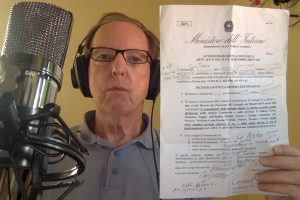
On March 9, 2020, Italy’s national government issued a national stay-at-home order. (See this March 24, 2020 Axios article.) By March 11, all bars and restaurants were closed. There was no ambiguity. We were to stay at home except for essential activities such as acquiring food and medicine and medical care. We were not to leave our towns. If you left the house you were to carry an “autocertificazione,” an affidavit stating who you are, where you live, where you are going and what is your purpose in going there. People who violated the stay-at-home order got stiff fines in the neighborhood of five hundred euros, which is over five hundred US dollars. Police were stationed at roundabouts and municipal boundaries and were checking papers. Cafes and restaurants were closed. Only pharmacies, newsstands, alimentari (like delicatessens), supermarkets, and a few others deemed essential were open.
So people stayed home. After more than two months, on May 18, 2020, we no longer were required to carry an autocertificazione. But there were still strong restrictions on travel and on gatherings. From March through June we, along with the whole world, watched the virus ravage northern Italy.
It’s fair to say that Italy did some things right and some things wrong. This excellent piece by the Harvard Business Review, published in late March, makes good reading today, three months later.
What kind of informal social pressure was there during the lockdown? If you didn’t wear a mask people would say something. Or at least glare. Old Italian ladies would yell at you and nobody is going to talk back to an old Italian lady. Norma complained of the disapproving looks she got when she was out on the street for any reason. The vibe was unpleasant. Everybody was unhappy. Nobody was making any money. It was a very sad time.
Luckily our town is surrounded by farms so there was never a problem acquiring food. And the food distribution infrastructure operated just fine. I think the city of Florence experienced some shortages but Castiglion Fiorentino did fairly well.
The lockdown was hard on everyone, perhaps more so on the local Italians because they like to hang out for hours at long tables elbow-to-elbow talking and yelling and eating and drinking. And they kiss each other a lot. But I would say that the Italian–and to some extent the European mindset—is not like the American mindset when it comes to governmental authority. They may flout regulations in a lot of ways, but people obeyed the lockdown and it has mostly worked.
I wish the same could be said about America’s response, but it seems to be a tragic failure of epic proportion.
Please learn from our experience in Italy, and do everything you can do to save lives and slow the spread of covid-19.

Facial Covering (mask), Ggloves and social distancing – the new normal